
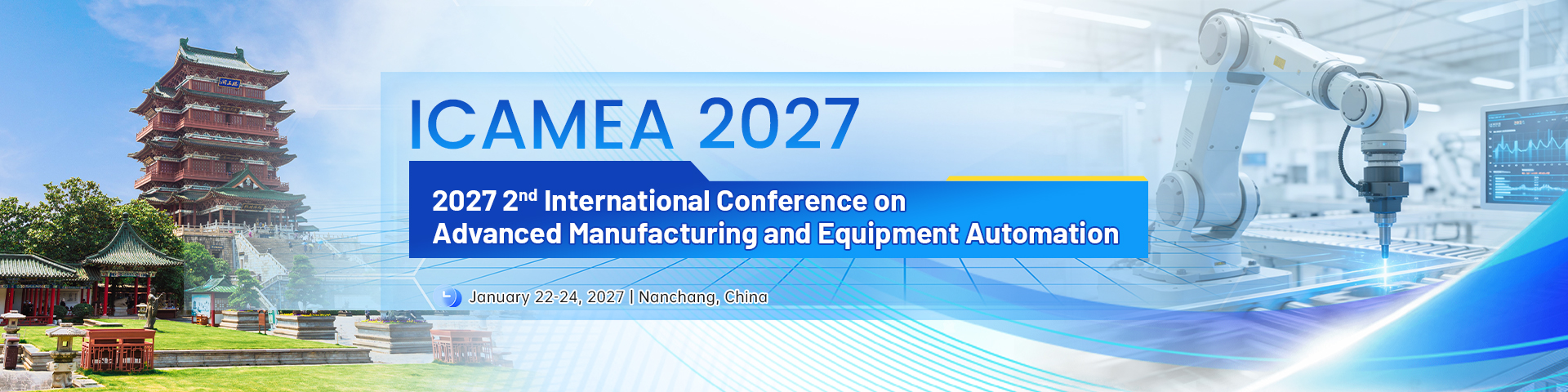
About ICAMEA 2027
To promote the green, standardized, sustainable, and healthy development of China’s advanced manufacturing and equipment automation sector, and to enhance scientific and technological innovation capabilities, the 2027 International Conference on Advanced Manufacturing and Equipment Automation (ICAMEA 2027) will be held in Wuhan from January 22 to 24, 2027. ICAMEA 2027 aims to advance interdisciplinary integration and the combination of industry, academia, and research. The conference will also delve into major theoretical and technical challenges in the field, so as to broaden research scope in advanced manufacturing and equipment automation technologies both in China and abroad.
The conference will focus on cutting-edge topics such as advanced manufacturing technologies, equipment automation, and intelligent manufacturing systems, with particular emphasis on current hot topics, focal issues, and challenging problems in the field. It will also summarize the latest research progress and key technologies in this area from both domestic and international perspectives.
ICAMEA 2027 sincerely invites experts, scholars, enterprise professionals, and other relevant participants from universities, research institutions, and industry around the world to attend and exchange ideas, share research achievements and cutting-edge technologies, gain insights into academic trends, and promote cooperation and the transformation of research outcomes, thereby contributing to the development of advanced manufacturing and equipment automation.
Important Dates
Full Paper Submission Date: November 8, 2026
Registration Deadline: December 8, 2026
Final Paper Submission Date:January 8, 2027
Conference Dates: January 22-24, 2027

Countdown to the Conference:
Conference Topics
The topics of interest for submission include, but are not limited to:
📚︎Advanced Manufacturing
1.Additive Manufacturing (3D Printing):
Material Selection and Development
Process Optimization and Control
Application Case Studies: Aerospace, Medical, and Related Fields
2.Precision Machining Technologies:
High-Speed Machining Technology
Ultra-Precision Machining Technology
Machining Parameter Optimization and Experimental Design
3.Flexible Manufacturing Systems:
Modular Production Line Design
Equipment Integration and Collaborative Operation
Real-Time Adjustment and Scheduling Strategies
4.Smart Manufacturing:
Adaptive Manufacturing and Reactive Systems
Applications of the Industrial Internet of Things (IIoT) in Manufacturing
Real-Time Data Analysis and Decision Support
5.Green Manufacturing:
Energy-Saving and Consumption-Reduction Technologies
Utilization of Renewable Materials
Life Cycle Assessment (LCA)
6.Production Process Monitoring and Diagnosis:
Sensing Technologies and Monitoring Systems
Fault Detection and Predictive Maintenance
Data-Driven Decision Support
7.Data Analysis and Optimization in Manufacturing:
Applications of Big Data in Production
Statistical Process Control and Quality Management
Applications of Machine Learning in Manufacturing Data
8.Human-Robot Collaboration and Smart Factories:
Design and Applications of Collaborative Robots (Cobots)
Collaboration Models Between Artificial Intelligence and Human Workers
Optimization of Work Environments and Safety Design
9.Simulation and Modeling Technologies
Numerical Modeling and Computational Fluid Dynamics (CFD)
Mechanism-Based Modeling for Manufacturing and Equipment Systems
Model Calibration Based on Physical Experiments and Operational Data
Simulation and Validation for Process Improvement and Smart Manufacturing
10.Innovative Materials and Processing Technologies
Applications of Reinforced and Composite Materials
Nanomanufacturing and Development of Novel Materials
Intelligent Materials and Studies on Their Applicability
📚︎MechanicalEngineering
1. Automatic Control Systems
PID Control and Advanced Control Technologies
Model Predictive Control (MPC)
Design and Implementation of Intelligent Control Systems
2. Sensing and Detection Technologies
Sensor Selection and Integration
Machine Vision Technologies
Wireless Sensor Networks (WSN)
3. Industrial Robots and Automation
Robot Path Planning and Control
Applications of Collaborative Robots (Cobots)
Behavior Recognition and Its Applications in Manufacturing
4. Automated Production Line Design
Equipment Integration in Automated Production Lines
Coordination Between Robots and Manipulators
Agile Manufacturing and Rapid Deployment
5. Remote Monitoring and Management of Equipment
Development of Remote Monitoring Technologies
Design of Equipment Management Systems
Energy Management and Optimization
6. Intelligent Instruments and Equipment
Development and Applications of Intelligent Instruments
Applications of IoT-Based Instruments in Automation
Intelligent Diagnosis and Maintenance Technologies
7. Automation Safety and Reliability
Safety Standards for Industrial Automation Systems
Fault Tree Analysis (FTA) and Risk Assessment
Emergency Response and Recovery Strategies
8. Automation for Industry 4.0
The Role of the Internet of Things in Industry 4.0
Digital Twins and Their Applications
End-to-End Intelligent Manufacturing Solutions
9. Energy Management and Optimization
Applications of Automation in Energy Management
Energy-Saving Solutions and Integration of Renewable Energy
Energy Monitoring and Analysis Technologies
10. Human-Machine Interaction in Automation Technologies
Design and Optimization of Human-Machine Interfaces (HMI)
Voice Commands and Natural Language Processing
Applications of Augmented Reality (AR) and Virtual Reality (VR) in Automation
Publication
All accepted full papers will be published in the conference proceedings and will be submitted to EI Compendex / Scopus for indexing.
Note: All submitted articles should report original research results, experimental or theoretical, not previously published or under consideration for publication elsewhere. Articles submitted to the conference should meet these criteria. We firmly believe that ethical conduct is the most essential virtue of academics. Hence, any act of plagiarism or other misconduct is totally unacceptable and cannot be tolerated.